
Hand Health
The Hidden Problem Behind Chronic Carpal Tunnel That Most Treatments Ignore

By Claire Whitlock
September 2026 - 8 min read

If you've been dealing with this hand condition for more than a month, and the splint, the ibuprofen, and the stretches aren't working anymore, there's a specific reason why. And it isn't what most people - or even many doctors - are telling you.
The condition you're treating today is not the same condition you had four weeks ago. The numbness feels the same. The diagnosis hasn't changed. But underneath, changes in the muscle above your wrist have transformed it into an entirely different problem, even though you haven't realised it. And almost no one explains this change.
To understand it, let's look at three of the most-studied facts about carpal tunnel on record.
In England alone, surgeons carry out tens of thousands of carpal tunnel operations every year, making it one of the most common operations on the NHS. Long-term follow-up studies found that for as many as 1 in 4 people, the numbness and tingling come back or never fully go away. And in the nerve test, a sizeable share of people with real, daily symptoms are handed a "mild" or "normal" result, which is widely reported in the research.
These people had access to the best hand surgeons in the country. And still, the numb hand followed them for years.
That isn't because they did anything wrong. It's because almost everyone - patients, GPs, and many surgeons - treats this hand condition as if it were the wrong condition.
Here's what's really going on.
2 Phases of Chronic Carpal Tunnel: Swelling and the Clamp
This isn't meant to scare you. The opposite, actually. Most people leave the doctor's office thinking carpal tunnel is a vague, "you'll just have to manage it" condition. It isn't. It's a specific muscle problem stemming from a specific underlying mechanism, and once you understand it, the path forward gets simpler.
There's a common misconception that steers so many patients in the wrong direction.
Carpal tunnel is often thought of mainly as a wrist problem. That's why the standard first-line approach involves a night splint, ibuprofen, and wrist stretches. And for the first four weeks after the numbness starts, that's correct. Early on, the problem is swelling around the tendons in the wrist. A splint, anti-inflammatories, and rest all help.
If you're inside that four-week window, most practitioners give simple, non-product advice: rest the hand as much as you reasonably can, wear the splint at night, and take anti-inflammatories as directed by your doctor. Most early tingling responds well to that approach.
That all changes once you've had carpal tunnel for more than four weeks. According to the long-term follow-up research, the condition itself transforms at that point. The swelling settles, and what takes its place is a completely different problem: forearm muscles that won't let go. A separate, often-cited study followed people for ten years after surgery; in a large share of cases, symptoms either returned or never fully went away. The tunnel had been opened. The muscle pulling on it never had.

Self-Check: Are You Still in the Swelling Phase?
Answer the following questions about your experience with carpal tunnel.
Have you had numbness or tingling for longer than four weeks?
Did the splint stop giving you relief when it used to help?
Do you wake in the night with a dead hand and shake it back to life, even though some weeks are worse than others?
If you answered "yes" to one or more, you've likely already crossed into the clamp phase. That's why whatever helped ease your hand early on stopped working. Keep reading to find out how to shift your approach to match the phase of the condition you're actually in.
The 4-Week Pivot Most People Never Hear About
Your carpal tunnel is the narrow passage of bone and ligament in your wrist that the nerve to your thumb runs through. Think of it like a corridor with nine ropes running down it and the nerve squashed in the middle. Those ropes are your tendons, and they're pulled from higher up by the big muscles on the inside of your forearm - the ones that close your hand. When the forearm pulls, the ropes go tight, the corridor closes in, and the nerve gets crushed, like a cable pinched in a door.
Here's the part many people miss. When the forearm stays tense, the tendons remain under constant pull and the hand begins guarding the exact opening-and-releasing movement that feels difficult. The more the hand avoids that movement, the tighter and less coordinated it becomes. A short-term irritation can turn into a repeating clamp cycle.
And while the forearm holds on, it drags those tendons tight and keeps the tunnel pulled shut. Every grip you take - on the kettle, the steering wheel, or the phone - squeezes the nerve a little more. At night your body finally rests the hand, and in the morning the forearm is still pulling, so the nerve wakes up crushed again. We call this the "clamp cycle."

The "Clamp Cycle" of Chronic Carpal Tunnel and How to Break It
If carpal tunnel keeps going unchecked, it doesn't stay at pins and needles.
Research shows unaddressed carpal tunnel leads to a weaker grip and a numb thumb. In other words, you start dropping things - mugs, keys, and your phone - to avoid the pain, and the discomfort can creep up the forearm and into the elbow. As the muscle stays clamped, the pad of the thumb can start to waste, and that doesn't come back. In severe cases, the nerve stops firing properly for good, which is exactly why operations performed later so often fail to bring the feeling back.
But with the right approach, you can disrupt the cycle. Your body wants to improve. In fact, it's designed to support itself. It just needs two things it hasn't been getting:
Controlled warmth and pulsing massage to warm stiff tissues around the hand and wrist, stimulate local circulation, and reduce the tight, guarded feeling before movement begins.
Guided movement and adjustable resistance through the individual fingers and grip, so the tendons practise opening, closing, and releasing without a sudden, forceful squeeze.
That is why HandEase does more than hold the wrist still: warmth and massage prepare the tissues around the tunnel, while guided finger movement, two-way resistance, and assisted extension give the tendons a repeatable path to bend, glide, and reopen. Instead of only reducing movement, the routine trains the movement the clamp cycle has taken away.

Why Splints, Ibuprofen, Jabs, and Other Approaches Stopped Helping
This also explains why everything you've tried so far hasn't worked. Not because you did anything wrong, but because those approaches were built for swelling, not for a clamped forearm. Here's a quick rundown of common approaches and why they fall short after week four.
The night splint: The splint stops your wrist bending in your sleep, and that helps in the swelling phase. But after the first few weeks, you don't have a swelling problem anymore. You have a forearm that won't let go. That's why you wake up numb with the strap still on.
Ibuprofen: Same here. Ibuprofen calms swelling, but if your wrist is no longer swollen, it doesn't help. And a tablet never reaches the muscle.
The steroid jab: The injection is great for shrinking the swelling around the nerve, and the first one can feel like a miracle. But once you're out of that phase, the second does nothing because it never opens the clamp.
Nerve glides and stretches: Both feel good momentarily, but you can't stretch a muscle that's already in spasm. Every pull just tightens it, and neither stops the tendons from crushing the nerve.
Braces, massagers and copper bracelets: A brace holds the wrist, and a massager buzzes on the surface, but neither does anything for the muscle above it. And if a brace sits in the wrong place, it might press on the tunnel that's already being pulled shut, making things worse.
None of these address the underlying cause of your numbness. That's not your fault. It's just that most of the solutions on the market were built around an outdated understanding of what carpal tunnel actually is.
The real issue is mechanical. Your nerve is being crushed because the forearm above it won't let go, and it gets crushed every time you close your hand. And if you're like most people, you close your hand thousands of times every day. So the solution has to do more than immobilise the wrist: it has to prepare the tissues, stimulate the hand, guide the fingers through controlled opening and closing, and rebuild the release motion without forcing the tunnel. That is the mechanical gap most passive solutions leave behind.

A Hand Physio's Mission: Address Carpal Tunnel for What It Is
That's the exact question a hand physiotherapist named Dr. Lisa Fernandez set out to answer.
Fernandez spent over 22 years working with hand and wrist patients in clinical practice, much of it focused on hand therapy. The pattern she saw, again and again, was the same one described above.

"By the time most patients walked through my door, they'd already tried everything that's designed for the first four weeks," she says. "The window had passed, and nobody had told them the problem had changed."
- Dr. Lisa Fernandez, Hand Physiotherapist
The project that led Fernandez to build the HandEase system did not begin as a strictly professional exercise. She watched her own mother lose both hands to it. The splint. Two jabs. Then both wrists operated on, one after the other. The second never took, and her mum ended up unable to do her own buttons or hold a cup of tea with one hand.
Fernandez had handed out everything she'd been trained to recommend: splints, nerve glides, and referrals for surgery. Nothing gave her mother lasting comfort. So she went looking for what was actually squeezing the nerve. It wasn't just the wrist. It was the combination of a forearm that stayed tense, stiff surrounding tissues, and a hand that never got a structured chance to release and move.
So she designed something new. Not another general-purpose wrist brace, but an active hand-therapy system built around the clamp itself: controlled warmth and pulsing massage prepare the tissues around the wrist, while individual finger guidance, adjustable resistance, grip work, and assisted extension train the hand to open, close, and release without suddenly overloading the tunnel.
That system is HandEase Hand Therapy System.
How It Works: Five Coordinated Actions
HandEase is built around five coordinated actions: prepare, stimulate, guide, resist, and reopen. Each one addresses a different part of the chronic carpal-tunnel cycle.
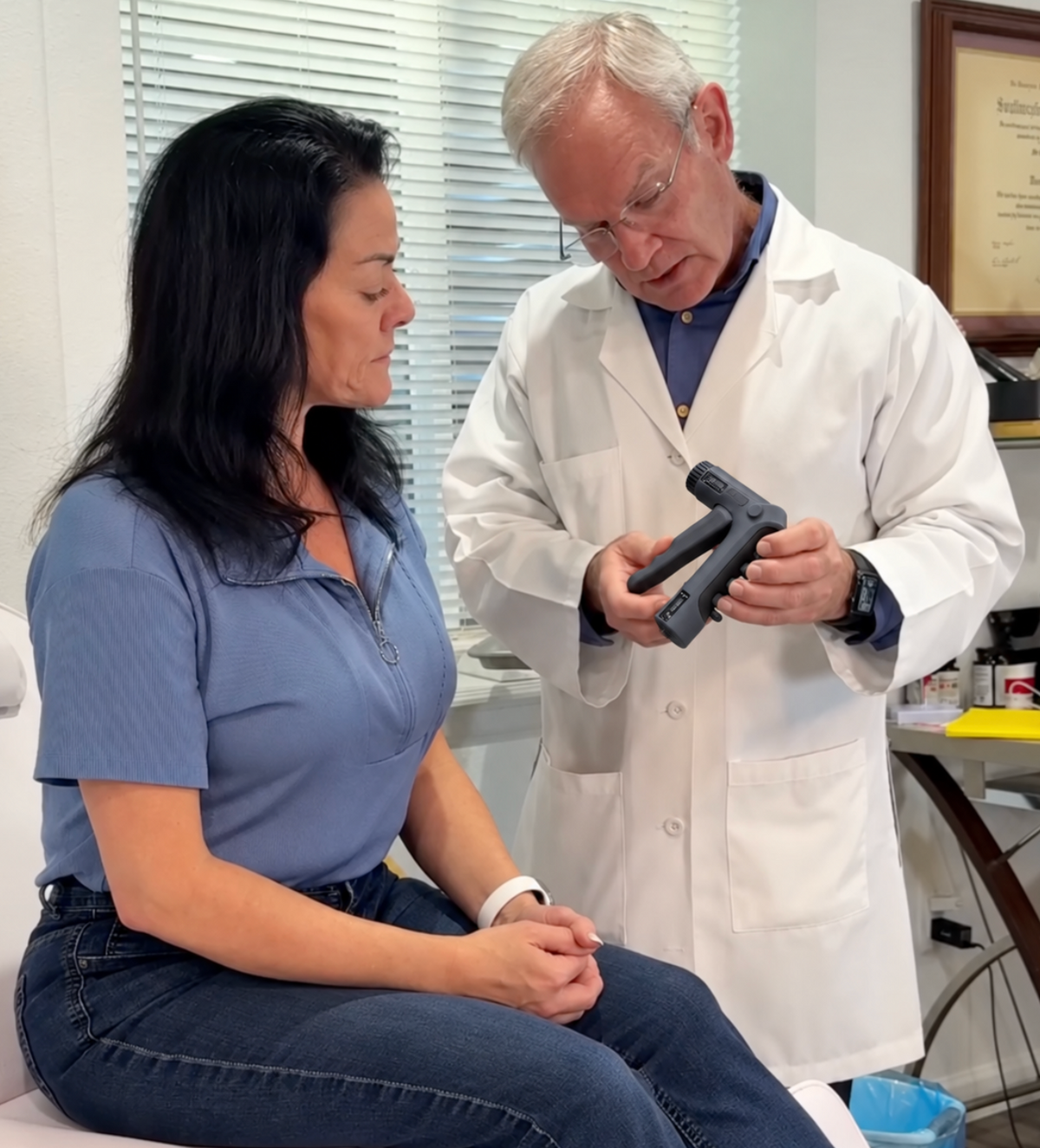
Controlled Warmth & Pulsing Massage: HandEase warms stiff tissues around the hand and wrist, then provides rhythmic stimulation beneath the palm and wrist. This prepares the area around the tunnel and helps the hand feel less tight before the movement work begins.
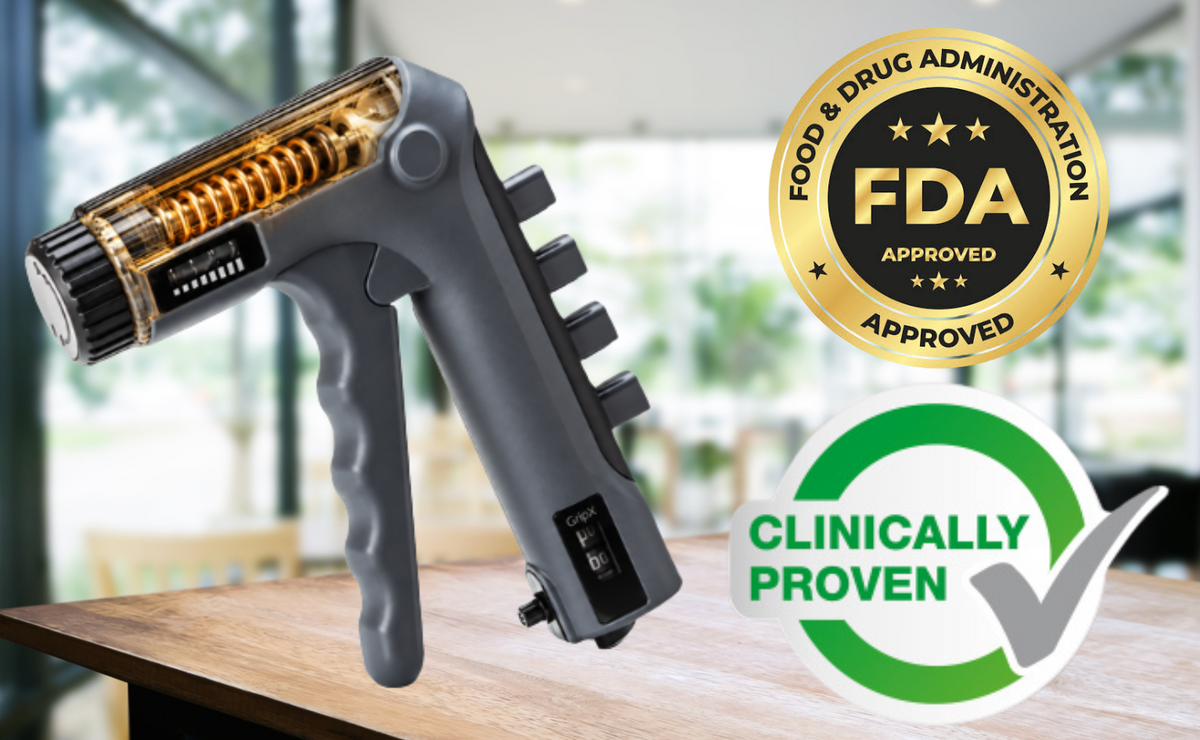
Guided Finger Movement & Adjustable Resistance: Individual buttons guide each digit through controlled bending and straightening while two-way resistance and the grip lever train the closing and reopening motions. Assisted extension helps the fingers return open when release feels restricted, while built-in sensing helps prevent excessive force.
So you get both at once. Warmth and massage prepare the hand and reduce guarded tension, while guided movement and adjustable resistance train the exact opening-and-releasing pattern that keeps the tendons moving through the tunnel. Used consistently, the sequence is designed to interrupt the clamp cycle at the movement level - not merely mask numbness for a few minutes.


Controlled Warmth
Prepares stiff tissues around the hand and wrist before movement begins, so the tendons can start moving without a sudden forceful squeeze.
Pulsing Massage
Provides rhythmic stimulation through the palm and wrist to help the area around the tunnel feel less tight as you work.
Guided Movement + Resistance
Individual buttons, adjustable two-way resistance, the grip lever, assisted extension, and force sensing build a controlled path for opening, closing, and releasing.
HandEase is also cordless and rechargeable. It needs no cream, no messy application, and nothing to swallow. Start with the warmth and pulsing massage, then guide the fingers and adjust the resistance to a level your hand can tolerate.
If you've already moved past the four-week window, this is the active hand-therapy system designed for the stage of carpal tunnel you're actually in. The product page dives deeper into the mechanism, the routine, and the guarantee.
What to Expect: Day 1 to Month 1
Here's what a typical experience can look like with consistent HandEase use.
Place your hand in HandEase, start with controlled warmth and pulsing massage, then guide each finger through a gentle sequence. Many users feel the burning and tightness begin to quiet within the first session, before the strengthening work even begins.
Nights start to feel different. Many users report that, within a week, they're waking to shake their hand twice a night instead of five times, and the dead, heavy feeling first thing in the morning begins to soften.
The burning becomes a dull tingle, and then fades further. Many users report sleeping a full night with the hand feeling more responsive in the morning, without needing to keep the wrist locked still.
At this point, many users say they realise they've held a full mug of tea in one hand without thinking about it until they've finished it. They're holding the phone in bed again. They're saying yes to things they would have turned down a month ago.
For many users, the numbness lessens significantly, and the forearm and hand have finally had repeated opportunities to release and move. They're driving with both hands on the wheel, opening jars, picking up the grandchildren. They start getting back to the life they'd been putting on hold.
Results may vary.
The more consistently you use the complete sequence, the longer the hand stays prepared. And it's worth knowing: carpal tunnel has one of the highest comeback rates of any hand condition, even after surgery. That's why many users keep using HandEase on demanding days, long shifts, long drives, and after a day in the garden, to keep the movement routine going. The longer-term part of the routine builds over roughly eight weeks, with short daily sessions.
What Users Are Saying

★★★★★
Retired nurse
Carol M., 61
"I've tried everything. Two splints. The steroid jab. Nerve glides. Nothing worked. Within two weeks of using HandEase for a short evening session, I slept through the night without shaking my hand for the first time in over a year. The warmth and guided movement made my hand feel usable again. I just lay there for a second. I couldn't believe it."

★★★★★
Dinner lady
Diane K., 57
"I've been on the tills all day since I was 22. I used to do every shift until one day my thumb and two fingers went numb while I was holding the scanner. I'm not ready to quit working. I use HandEase after my shift with the resistance turned down, then finish with the grip lever. Now I don't spend the whole day worrying about my hands."

★★★★★
Retired postman
Graham T., 64
"2 weeks. I know it's hard to believe. I used HandEase for 15 minutes a day - warmth first, then guided movement and gentle resistance - to see if it would help with the numb hand I'd had for years. It's already been 3 months, I'm back on the allotment, and I haven't dropped a mug since."

★★★★★
Hairdresser
Ruth J., 52
"I was very sceptical. I've wasted so much money on things that didn't work. But this was different. I hold the scissors all day, and the pins and needles I've had for years are almost completely gone. I use HandEase every evening with the warmth and finger guidance first, and I'm ordering a second one for my other hand."
To date, more than 12,138 people have used the HandEase Hand Therapy System. Right now, HandEase is running a special promotion: 62% off, with free tracked UK delivery.
That's worth knowing, because carpal tunnel recovery depends on consistent daily use. You wouldn't expect one short session to carry you for eight weeks - when your routine is consistent, you give the hand the repeated movement it needs. The same principle applies here. And 6 in 10 people have it in both hands.
The total cost of a HandEase system is also far less than what most people spend on doctor visits, injections, braces, physiotherapy, and the running list of products that don't address what's really going on in your hand: a forearm and hand that stay tight and underused.
There's also a 60-day money-back guarantee, so there's no reason not to give it a try. HandEase is a small company, and because each system requires calibrated finger guides, adjustable resistance, and assisted extension, they can only produce a limited number of devices per month. Every time they run the 62% off offer, it's historically sold out within days.
Your hands have already carried you this far.
SOURCES
Atroshi I, Gummesson C, Johnsson R, Ornstein E, Ranstam J, Rosén I. JAMA. 1999;282(2):153-158.
Bland JDP. BMJ. 2007;335(7615):343-346.
Louie DL, Earp BE, Collins JE, et al. Journal of Bone and Joint Surgery. 2013;95(12):1067-1073.
Jablecki CK, Andary MT, Floeter MK, et al. Neurology. 2002;58(11):1589-1592.